37 Hard Orchids | 2026 Guide
Find 37 hard orchids. Complete guide for your garden.
37 Orchids with hard level
Showing 1-36 of 37

Green-winged orchid
Anacamptis morio
Anacamptis morio, the green-winged orchid, is a tuberous terrestrial orchid native to Europe, North Africa and the Middle East. It grows in unimproved, nutrient-poor grassland and meadows, producing a short spike of purple-to-pink (occasionally white) helmet-shaped flowers marked with green veins in spring. The plant is dormant through summer, re-sprouting a basal leaf rosette in autumn, and depends entirely on symbiotic soil fungi to germinate and thrive.
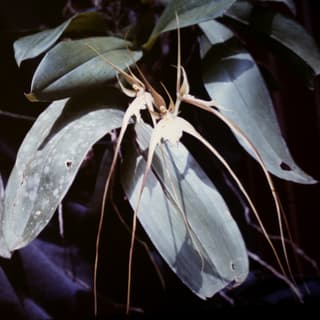
Spider Orchid
Brassia caudata
Brassia caudata, commonly known as the Spider Orchid, is a neotropical epiphytic orchid native to southern Mexico, Central America, the Caribbean, and northern South America. Its striking flowers feature long, spider-leg-like sepals and petals in yellow with brown markings, reaching up to 15 cm in length. It is a slow-growing evergreen perennial that blooms primarily in spring and summer.
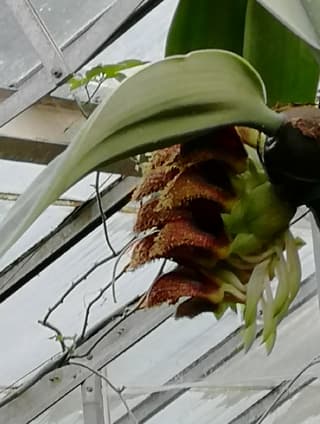
Stinking Orchid
Bulbophyllum phalaenopsis
Bulbophyllum phalaenopsis is one of the largest orchids in the Bulbophyllum genus, native to the tropical rainforests of New Guinea. It is notorious for its massive leaves, which can exceed 60 cm in length, and for its flowers that emit a powerful putrid odor — an evolutionary strategy to attract fly pollinators. Despite its unusual smell, it is a prized specimen among serious orchid collectors.
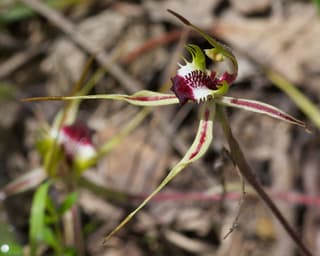
Small Spider-orchid
Caladenia parva
Caladenia parva is a small terrestrial orchid endemic to southeastern Australia, found in scattered areas of southern Victoria and the far southeast of South Australia. It is a deciduous perennial herb with a single underground tuber and a single narrow leaf 3 to 10 cm long, usually with small red spots at the base. Between September and November (southern spring), it produces one or two greenish flowers with red stripes on a 5 to 15 cm stem, featuring a greenish-white labellum with a curled dark red tip. It grows in open forests, woodlands, and coastal vegetation in well-drained sandy-clay soils.
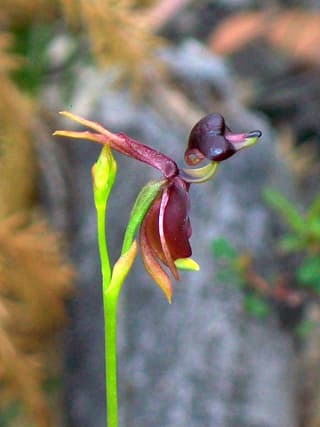
Flying Duck Orchid
Caleana major
The Flying Duck Orchid (Caleana major) is one of the most extraordinary flowering plants in the world. Native to eastern and southern Australia, this small terrestrial orchid produces remarkable reddish-brown flowers whose labellum bears a striking resemblance to a duck in flight. It grows 20–40 cm tall and flowers from spring through summer. Pollination occurs via male sawflies that are deceived into pseudocopulation with the duck-shaped labellum.
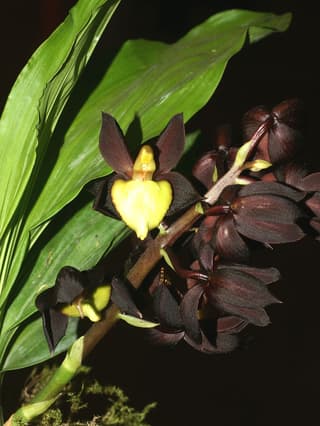
Catasetum
Catasetum
Catasetum is a genus of roughly 166 species of deciduous, epiphytic orchids native to the tropical forests of Mexico, Central America, the Caribbean, and South America as far south as Argentina. Plants form clusters of ribbed, fleshy pseudobulbs topped with pleated leaves that are shed completely once each year. Catasetum is famous among orchid growers for producing separate male and female flowers, sometimes even on the same inflorescence, and for its explosive pollination mechanism: brushing the antennae-like appendages on a male flower triggers the column to catapult a sticky pollen packet onto a visiting insect.
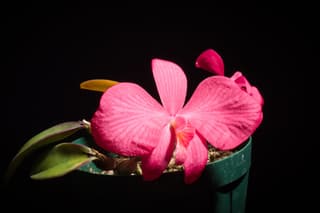
Wittig's Cattleya
Cattleya wittigiana
Cattleya wittigiana is a mini-miniature epiphytic orchid native to the misty cloud forests of the Mata Atlantica in Espirito Santo and Minas Gerais, Brazil, where it clings to mossy, rough-barked trees at elevations of 700-2000 m. Formerly classified as Sophronitis wittigiana (and closely related to Cattleya coccinea), it produces tiny globular pseudobulbs, each topped with a single stiff leathery leaf, yet surprises growers with rose-pink to magenta flowers 4-6.5 cm across during the winter months. In habitat it is pollinated by hummingbirds and thrives in cool, bright, windy, humid conditions typical of exposed mountain ridges.
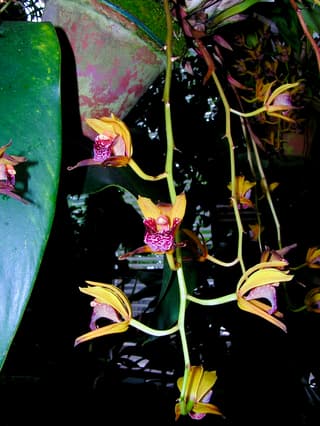
Devon's Cymbidium
Cymbidium devonianum
Devon's Cymbidium (Cymbidium devonianum) is an epiphytic orchid native to the Himalayan foothills of Nepal, northeast India, Bhutan, and Myanmar. It is prized for its striking pendant flower spikes bearing 15–35 blooms in yellow-green with purple-red markings, making it one of the most distinctive species in the Cymbidium genus.
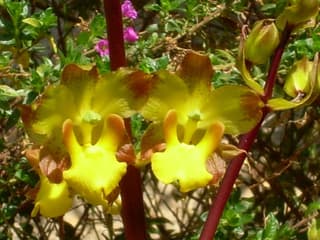
Cowhorn orchid
Cyrtopodium
Cyrtopodium is a genus of terrestrial, epiphytic, or lithophytic orchids native to the tropical and subtropical Americas, from southern Florida to Argentina, with a strong presence in Brazil. Recognized for its large, spindle-shaped, and wrinkled pseudobulbs resembling cigars or horns, the genus produces tall flower spikes covered in dozens of yellow flowers with brown spots. The plicate leaves drop before flowering, in a cycle marked by a period of vigorous growth followed by dormancy.
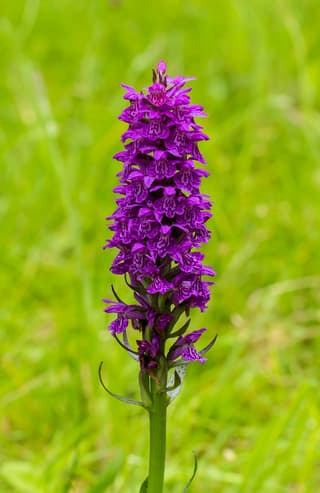
Heath Spotted Orchid
Dactylorhiza maculata
Dactylorhiza maculata, the heath spotted orchid, is a terrestrial tuberous perennial orchid native to Europe. It thrives in heathlands, damp meadows, bogs, and marshes, producing dense spikes of pale pink to deep purple flowers with characteristic dark markings on the labellum. Its leaves are distinctively spotted.
Closterium Dendrobium
Dendrobium closterium
Dendrobium closterium is a miniature epiphytic (occasionally lithophytic) orchid native to New Caledonia, where it grows on small trees and rocks from sea level up to 1000 m in scrubland. It has medially swollen, cane-like stems bearing 2 to 5 leathery, elliptic leaves with unequally bilobed tips. In late spring to early summer it produces erect to arching inflorescences carrying 2 to 20 small, delicate flowers around 2-3 cm across, arising from nodes near the stem apex.
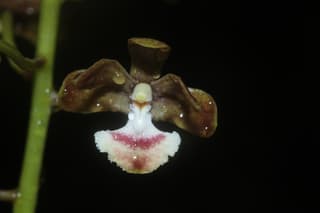
Virot's Dendrobium
Dendrobium virotii
Dendrobium virotii is a rare endemic orchid from New Caledonia, first described by Guillaumin in 1941. A medium-sized epiphyte, it grows on tree trunks in montane rainforests and scrubland at elevations from sea level to 1,000 meters. Its slightly zigzag, branching stems carry elliptic, clasping leaves, and in late spring it produces small racemes of 6 to 22 delicate flowers.
Hyacinth Orchid
Dipodium squamatum
Dipodium squamatum is a rare, leafless, mycoheterotrophic terrestrial orchid of the family Orchidaceae. Native to eastern Australia (Queensland, New South Wales, Victoria, and South Australia), New Caledonia, and Vanuatu, this species is one of the most challenging orchids to study and conserve. Completely lacking photosynthetic leaves, it depends entirely on fungal symbiosis for its nutrients. The erect, reddish-brown flowering stem reaches up to 100 cm tall, bearing 9 to 60 pink to purple flowers, each approximately 2.5 cm across. Blooms occur in summer and fall across its Southern Hemisphere range. In its native habitat, it inhabits open forests, woodlands, drier ridges, and coastal areas at elevations from 10 to 1100 meters in well-drained soils.
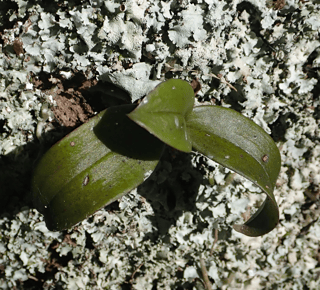
Green Fleshy Tree Orchid
Drymoanthus adversus
Drymoanthus adversus, commonly known as the Green Fleshy Tree Orchid, is a miniature epiphytic orchid endemic to New Zealand. It grows attached to tree trunks and branches in coastal to montane forests, forming compact tufts of dark green, fleshy leaves sometimes spotted with purple. In spring and early summer it produces small racemes of greenish-white flowers flecked with red.

Night-Scented Orchid
Epidendrum nocturnum
Epidendrum nocturnum, commonly called the night-scented orchid, is an epiphytic orchid native to Florida, the Bahamas, the West Indies, and Central America through to northern Brazil and the Guyanas. It grows tall, leafy reed-like stems up to about a meter high, topped with clusters of green to yellow-brown flowers with a broad white lip. The blooms open with a subtle daytime scent but release a powerful, sweet fragrance -- often compared to eucalyptus or anise -- after dark, which is how the species earned its name.
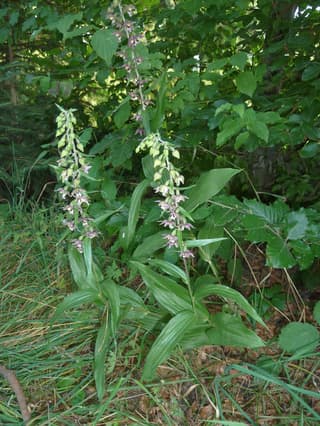
Helleborine
Epipactis
Epipactis is a genus of roughly 54 accepted terrestrial orchid species found across the temperate and subtropical regions of Europe, Asia, North Africa, and North America. Unlike the tropical epiphytic orchids seen in most collections, Epipactis species grow directly in the ground from creeping, fleshy rhizomes, sending up one or several leafy stems each year from spring through late summer. They favor the dappled light of open woodland, hedgerows, and scrub, though several species - including the North American Stream Orchid (Epipactis gigantea) - are equally at home along the damp margins of streams, springs, and lakes. A defining trait of the genus is its total dependence on mycorrhizal fungi in the soil: seeds carry almost no stored energy and cannot germinate without a fungal partner, and even mature plants rely on this underground relationship to take up nutrients. Flower spikes bear numerous small, often drooping blooms in shades of green, white, purple, and dusky pink, generally opening from midsummer into autumn. The best-known species, Epipactis helleborine, has proven remarkably adaptable, naturalizing far beyond its native Eurasian range and now appearing as a common, sometimes weedy, colonizer of parks, gardens, and city sidewalks in North America. Because of their fungal dependency, Epipactis orchids are considered specialist wild and woodland-garden plants rather than typical houseplants.
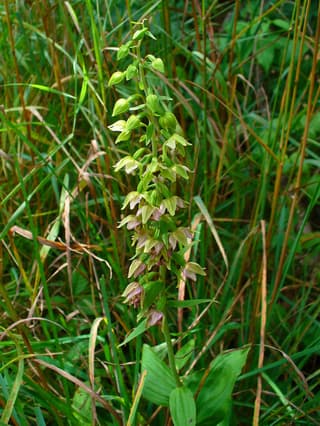
Broad-leaved Helleborine
Epipactis helleborine
Epipactis helleborine, commonly known as the broad-leaved helleborine, is a terrestrial orchid native to Europe and Asia. It grows in woodland settings, relying on mycorrhizal fungi for germination and survival. Its tall stems bear broad, ribbed leaves and a drooping raceme of greenish-purple flowers that bloom in summer.
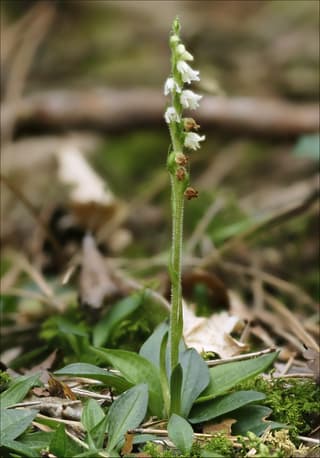
Creeping lady's-tresses
Goodyera repens
Creeping lady's-tresses (Goodyera repens) is a small, evergreen terrestrial orchid that spreads across the temperate coniferous and mixed forests of the Northern Hemisphere in Europe, Asia, and North America. The plant forms slowly expanding colonies via rhizomes in old, undisturbed coniferous forests, and its dark green leaves are decorated with a silvery-white reticulated pattern. From July to September, the plant produces a 10-20 cm tall one-sided inflorescence, bearing 7-36 small white or pale green hairy flowers. The orchid lives in close symbiosis with mycorrhizal fungi, upon which its seedlings are entirely dependent.
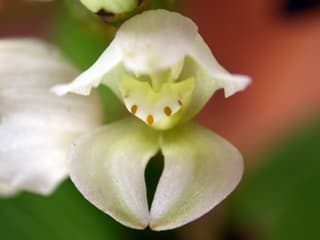
Govenia
Govenia
Govenia is a genus of terrestrial (rarely epiphytic) orchids belonging to the Orchidaceae family, comprising about 20–24 species. It naturally occurs in the mountainous pine-oak forests of Mexico, Central and South America (as far as Peru and Bolivia), and the Caribbean; a single taxon, now extinct (Govenia floridana), grew in Florida. The plants produce bulbous corms covered by membranous sheaths, from which usually two plicate (pleated) leaves emerge. The leaves are shed seasonally – in some species, flowering occurs while the leaves are still present, in others only after they have completely withered. The inflorescence forms a raceme of several to a dozen bright, usually white or cream-colored flowers, often speckled with purple or crimson, which do not fully open.

Giant Orchid
Grammatophyllum speciosum
Grammatophyllum speciosum is the world's largest orchid species, an epiphytic giant native to the rainforests of Southeast Asia. It forms massive clumps of cane-like pseudobulbs that can reach over 2.5 meters long, with clusters weighing several hundred kilograms in the wild. Its striking yellow flowers marked with maroon blotches appear in dense, arching racemes, making it a prized specimen for botanical gardens and serious orchid collectors.
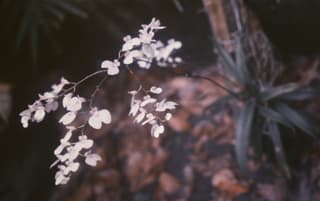
Delicate violet orchid
Ionopsis utricularioides
Ionopsis utricularioides is a small epiphytic orchid native to the Neotropics, from Florida and the Caribbean through Central and South America. It forms compact fans of stiff leaves and sends up airy, branched sprays of many small white-to-violet flowers, each with a broad, veined lower lip.

Grasshopper orchid
Lycaste locusta
Lycaste locusta, also classified as Ida locusta or Sudamerlycaste locusta, is a large, cool-to-warm growing orchid native to Peru, where it grows as a lithophyte on sunny limestone embankments and rocky slopes between 2,000 and 3,000 meters elevation. Its oblong pseudobulbs support 2-3 broad, pleated, elliptic-lanceolate leaves reaching up to 80 cm long, and in cultivation it blooms in spring (fall in the wild) with pendant, waxy, green flowers up to 11.5 cm across and a fringed lip, carrying a distinct scent of apples.
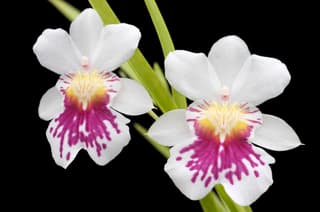
Pansy Orchid
Miltoniopsis phalaenopsis
Miltoniopsis phalaenopsis, commonly known as the Pansy Orchid, is a cool-growing epiphytic orchid native to the cloud forests of the Colombian Andes. Its large, flat blooms closely resemble garden pansies and come in shades of white, yellow, pink, red and purple with distinctive waterfall patterning. It is considered one of the most beautiful orchids in cultivation but requires cool temperatures and high humidity.
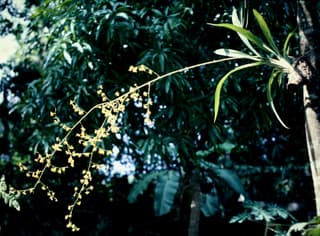
Bauer's Dancing Lady Orchid
Oncidium baueri
Oncidium baueri is an epiphytic orchid native to South America, celebrated for its graceful sprays of yellow and brown dancing-lady flowers that sway gently in the breeze. First described by Lindley in 1833, it is widely prized in orchid collections worldwide for its reliable flowering and elegant form.
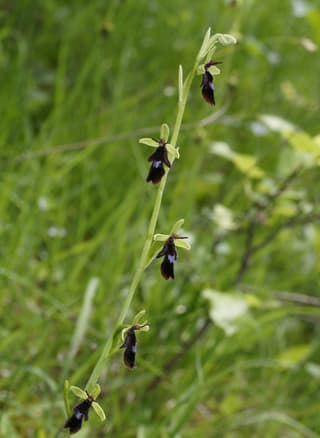
Fly Orchid
Ophrys insectifera
Ophrys insectifera, commonly known as the fly orchid, is a European terrestrial species notable for its pollination strategy. Its flowers have evolved to visually and chemically mimic the females of certain wasp and fly species, tricking males into performing pseudocopulation, which ensures pollen transfer. It is a small plant with a rosette of basal leaves and a slender inflorescence.
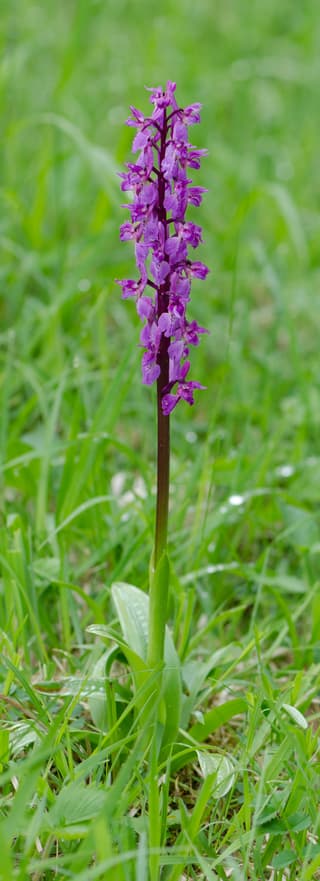
Early-purple orchid
Orchis mascula
Orchis mascula is a tuberous terrestrial orchid native to Europe, North Africa, and parts of Asia. It produces dense spikes of purple to pinkish flowers in the spring, rising above a rosette of leaves that are often spotted with dark purple. Unlike tropical orchids grown as houseplants, this is a wild species of woodlands and meadows that relies on a symbiotic soil fungus (mycorrhiza) to survive, making it notoriously difficult to cultivate outside its natural habitat. In many European countries, it is a protected wildflower and should never be removed from the wild.
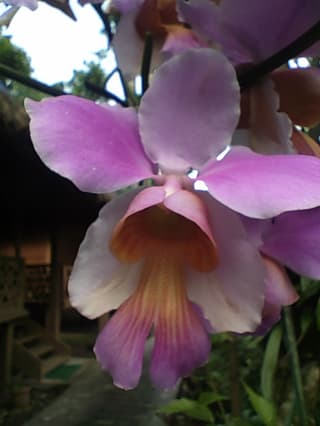
Terete Vanda
Papilionanthe teres
Terete Vanda (Papilionanthe teres) is a giant epiphytic orchid native to the eastern Himalayas, India, Myanmar, Thailand, Laos and Vietnam. It has a branching monopodial stem with long cylindrical (terete) leaves, the feature that gives the plant its common name. Large, fragrant magenta-pink flowers with a white-and-yellow lip appear mostly in late spring and early summer.
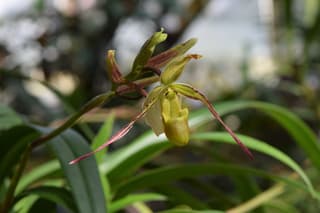
South American Slipper Orchid
Phragmipedium
Phragmipedium is a genus of roughly 20 species of sympodial slipper orchids native to the cloud forests and wetlands of Central and South America, from Mexico south to Peru and Brazil. Unlike their cousins Paphiopedilum, many Phragmipediums grow naturally with their roots submerged in seepage water or streambanks, giving them a reputation as the moisture-loving slipper orchids. Each fan of strap-like evergreen leaves sends up an arching spike bearing one or more pouch-shaped flowers, and in species like Phragmipedium besseae and its hybrids the spike can continue producing new blooms for months. Because of their unusual constant-moisture requirement combined with a need for excellent aeration around the roots, Phragmipediums are considered a rewarding but intermediate-to-advanced orchid to grow well.
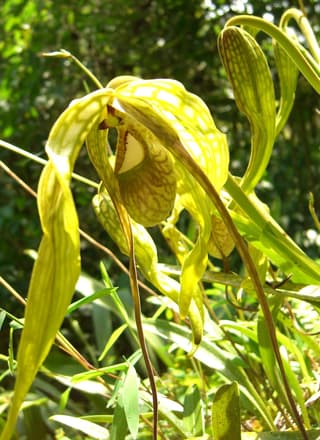
Tailed Slipper Orchid
Phragmipedium caudatum
Phragmipedium caudatum is a large, fan-shaped terrestrial to lithophytic orchid native to cloud forests from Mexico to Peru and Bolivia, growing on humid, mossy slopes and cliff faces between 800 and 2500 meters elevation. It is famed for its extraordinarily long, spiraling lateral petals, which trail downward and can reach 60 to 90 centimeters (occasionally over a meter) in mature specimens, among the longest floral structures in the plant kingdom. The cream to yellow-green flowers are veined with darker green and flushed with maroon-red along the twisting petals, opening in succession over many weeks. Prized by collectors since Victorian times, it remains one of the most spectacular and challenging slipper orchids to grow well.
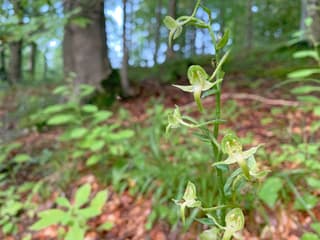
Greater Butterfly-orchid
Platanthera chlorantha
The Greater Butterfly-orchid (Platanthera chlorantha) is a tuberous orchid native to European forests, calcareous meadows, and marshy areas. Growing 30-60 cm tall, it features two shiny, elliptical basal leaves and smaller, oblong stem leaves. Its greenish-white, vanilla-scented flowers are arranged in a sparse inflorescence and feature a long spur adapted for pollination by nocturnal moths, such as noctuids and hawkmoths. Unlike the closely related Platanthera bifolia, its pollinaria attach between the pollinator's eyes rather than to the proboscis. The plant is specialized for calcareous and neutral soils and depends on mycorrhizal fungi for both germination and growth.
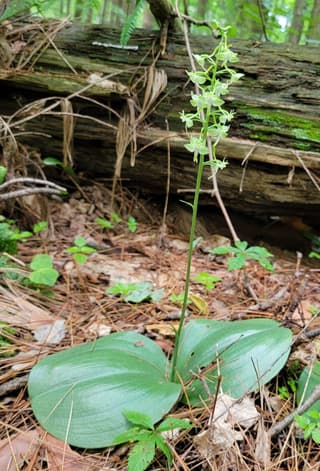
Large Round-leaved Orchid
Platanthera orbiculata
A native North American terrestrial orchid found in moist coniferous and deciduous forests from Canada down to the eastern and northern United States. Easily recognized by its pair of large, glossy, rounded basal leaves lying flat on the forest floor and a tall spike of up to 30 greenish-white flowers with long spurs, pollinated mainly by noctuid moths.
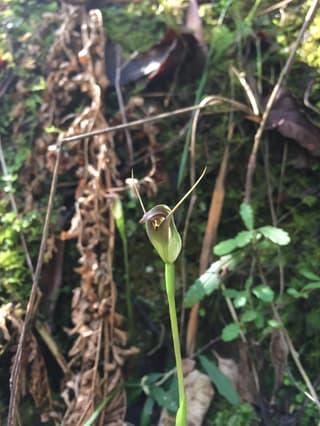
Maroonhood
Pterostylis pedunculata
Pterostylis pedunculata, the maroonhood, is a small terrestrial orchid endemic to south-eastern Australia. From an underground tuber it produces a rosette of stalked leaves and a single hooded flower that is white and green at the base and stained deep reddish-brown to maroon over the hood, or galea. It is a winter-growing, colony-forming greenhood of forests and woodlands, sometimes even growing on the fibrous trunks of tree ferns.
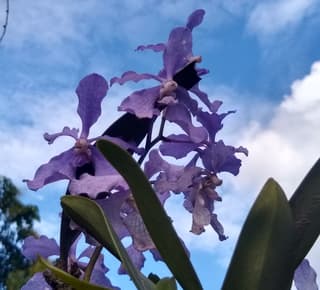
Vanda Orchid
Vanda
Orchids of the genus Vanda are tropical epiphytes known for their striking aerial roots and vibrant flowers, including the rare natural blue. Unlike other orchids, they are not typically grown in dense potting media, preferring hanging baskets that allow their roots to be exposed to air and light.
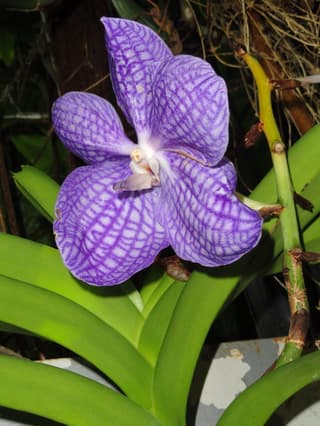
Blue Vanda Orchid
Vanda coerulea
Vanda coerulea, commonly known as the Blue Vanda Orchid, is one of the most celebrated and rare orchids in the world. Native to the forests of Northeast India, Myanmar, and Thailand, it produces breathtaking tessellated violet-blue flowers in autumn. Now critically endangered in the wild due to over-collection, it is a protected species and a symbol of botanical conservation.
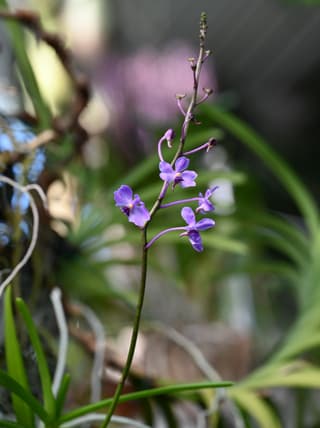
Blue Vanda
Vanda coerulescens
Vanda coerulescens is a miniature epiphytic orchid native to the highland forests of Myanmar, China, and Thailand. Celebrated for its delicate pale blue-violet fragrant flowers, it is one of the rarest naturally blue orchids in the world. Each inflorescence bears 15 or more blooms about 1 inch across, with a pleasant fragrance and long-lasting display.

Palm Vanilla Orchid
Vanilla palmarum
Vanilla palmarum is a climbing, epiphytic orchid of the family Orchidaceae, native from Cuba to southern Brazil, occurring across biomes such as the Amazon, Caatinga, Cerrado, Atlantic Forest and Pantanal. It grows twining over host palm trees (such as Syagrus and Attalea), from which it gets its common name. It has comparatively delicate stems, chlorophyllous aerial roots, large reticulated leaves, and pale yellow-green flowers borne in successive lateral racemes in spring. It is considered an endangered species across part of its range.
Hard Care Orchids
Our selection of 37 hard orchids combines the characteristics of this category with specific care needs. For enthusiasts seeking a challenge.
Why Choose Hard Orchids?
Combining the beauty of orchids with hard difficulty level lets you enjoy this category while developing your gardening skills. Each plant was selected to offer the best characteristics of the category at the care level you are looking for.