Complete Plant Guide
Explore plants by difficulty, season and more. Find the perfect plant for you.
Difficulty
Categories
Plants by City
🗺️ Plants by City3478 plants found
Showing 1225-1260 of 3478
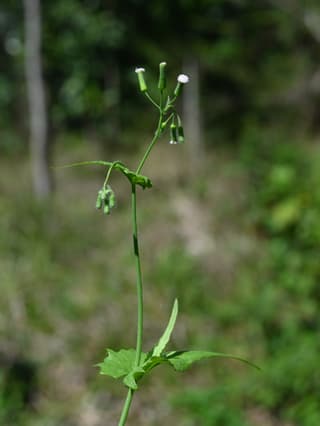
Lilac tassel flower
Emilia sonchifolia
The lilac tassel flower (Emilia sonchifolia) is an annual herbaceous plant in the Asteraceae family, native to tropical Asia and now naturalized in many regions, including the Americas. It grows upright with a cylindrical, tender, and sparsely branched stem, reaching 30 to 70 cm in height. Basal leaves form a rosette, while stem leaves are arranged spirally; the tubular flowers, ranging from lilac to pink, gather in small terminal heads that resemble a brush—hence the common names Cupid's shaving brush and Flora's paintbrush. A hardy and spontaneous plant, it is found along roadsides, vacant lots, gardens, and cultivated areas, where it often behaves as a common weed.
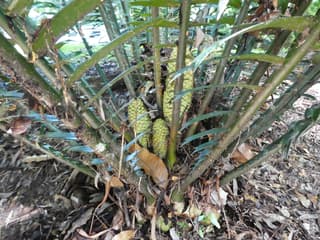
Bread Palm
Encephalartos
Encephalartos is a genus of African cycads commonly called "bread palms," a name derived from the starchy stem pith historically processed into a bread-like food by indigenous peoples of southern and eastern Africa. Despite the common name, they are not true palms but ancient gymnosperms — living fossils that predate the dinosaurs. They form a rosette of stiff, pinnate leaves, sometimes blue-tinted or heavily armed with spines, atop a thick woody stem or trunk. Plants are dioecious, producing large male and female cones. Growth is extremely slow, and individuals can live for centuries. Nearly all species are listed on CITES Appendix I due to severe poaching pressure.

Fragrant Encyclia
Encyclia fragrans
The Fragrant Encyclia (Encyclia fragrans, syn. Prosthechea fragrans) is a sympodial epiphytic orchid native to tropical forests and cloud forests of Mexico, Central America, the Caribbean (Jamaica, Puerto Rico), and northern South America (Brazil, Ecuador, Costa Rica). It forms compact oval pseudobulbs, each with a single leathery, upright leaf, and produces stems with fragrant greenish-white to cream flowers, featuring a white lip streaked with purple stripes. The flowers exude a sweet aroma reminiscent of honey and vanilla, which is most intense at night.

Engler's False Arum
Englerarum hypnosum
Englerarum hypnosum is a rare monotypic tropical aroid native to limestone karst forests of Southwest China, Laos, and Thailand. Formerly classified under Alocasia, it was segregated into its own genus Englerarum following molecular phylogenetic studies. It grows as a lithophyte on humid limestone ledges at 800–1000 m elevation, spreading by rhizomes to form colonies. Its large, deep-green leaves with silvery-green patterning make it a striking ornamental houseplant.
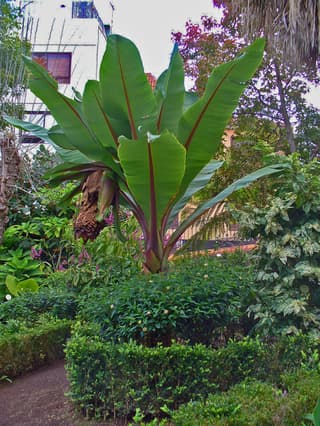
Abyssinian Banana
Ensete ventricosum
Ensete ventricosum, commonly known as the Abyssinian Banana or False Banana, is a dramatic tropical plant in the Musaceae family, native to the highlands of East Africa and Ethiopia. It produces enormous paddle-like leaves up to 6 metres long with a distinctive reddish midrib, making it one of the most striking specimen plants for large gardens and conservatories. Unlike true bananas, its fruits are inedible; instead, the pseudostem, corm, and inflorescence provide a fermented starch staple called kocho, feeding approximately 20 million Ethiopians for over 10,000 years.

Elephant Ear Tree
Enterolobium contortisiliquum
The Elephant Ear Tree is a native tree of the Brazilian Atlantic Forest and Cerrado, belonging to the Fabaceae family. It can reach heights of 20 to 35 meters with a trunk diameter of up to 1.6 meters. It is famous for its wide, umbrella-shaped canopy and its woody, curved, hollow fruits that resemble a human or monkey ear (and a small drum, which is the origin of the Portuguese name 'tamboril'). A fast-growing deciduous pioneer species, it produces small white globular flowers between winter and summer and is widely used in reforestation, urban forestry, and large-scale landscaping.
Silky Pinkgill
Entoloma sericeum
Entoloma sericeum, commonly known as the Silky Pinkgill, is a small mushroom species primarily found in grasslands, pastures, and gardens. Its cap is dark brown or grayish-brown with a silky sheen and is hygrophanous, meaning its color changes depending on moisture levels. The gills are initially grayish-white, turning a pinkish hue as the spores mature. It is important to note that while not lethally toxic, it can cause gastrointestinal distress and is therefore considered inedible.

Wallaba
Eperua falcata
Eperua falcata is a rainforest tree in the legume family (Fabaceae), native to northern South America, primarily the Guianas (French Guiana, Suriname, Guyana) and northern Brazil (Amapá). It grows up to 35 meters tall, featuring grayish-brown bark and pinnately compound leaves consisting of 2-4 pairs of ovate leaflets approximately 18 cm long. Its bell-shaped flowers with red petals bloom in pendulous clusters and are highly decorative, while its ripening, mauve-pink, sword-shaped pods can eject seeds up to 30 meters away upon opening. The tree often forms pure stands on white quartz sands in riverine and swampy rainforests, up to elevations of 700 meters. Its reddish-brown heartwood is extremely durable; due to its natural fungal resistance, it is used for piles, shingles, and telegraph poles.
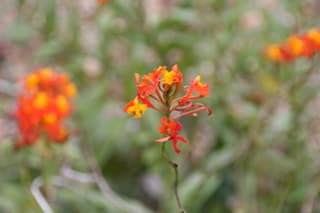
Crucifix Orchid
Epidendrum
Epidendrum is one of the largest orchid genera, comprising approximately 1,500 species native to the Neotropical regions of Central and South America. Commonly called the Crucifix Orchid (especially E. radicans), it produces clusters of small, star-shaped flowers in vibrant shades of red, orange, yellow, pink, and white. It is exceptionally resilient and easy to grow, making it ideal for beginner orchid enthusiasts.
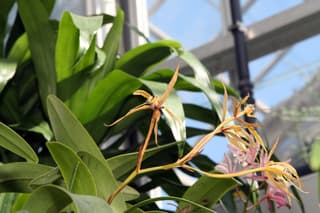
Fringed Star Orchid
Epidendrum ciliare
Epidendrum ciliare, commonly known as the Fringed Star Orchid, is a stunning epiphytic orchid native to Mexico, Central America, the Caribbean, and northern South America. It grows on trees and rocky outcrops in humid forests at elevations of 500–1000 metres. The plant produces elongated cylindrical pseudobulbs 10–20 cm long, topped with 1–2 glossy, oblong leaves. Its star-shaped flowers are renowned for their finely fringed white labellum and elegant greenish-yellow sepals and petals, blooming typically in winter. This long-cultivated species is a favourite among orchid enthusiasts for its dramatic, fragrant blooms and relative ease of care.
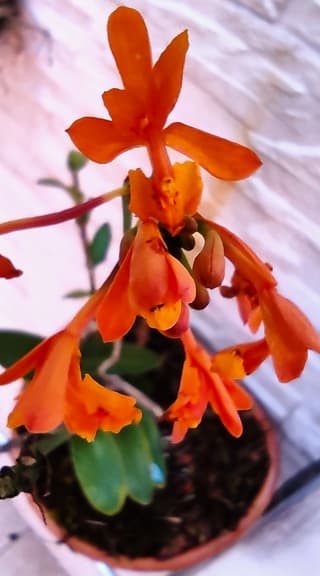
Beach Crucifix Orchid
Epidendrum fulgens
Epidendrum fulgens is a terrestrial crucifix orchid native to the restinga (coastal scrubland) of southern and southeastern Brazil, from Rio de Janeiro to Rio Grande do Sul. It forms robust clumps of cane-like pseudobulbs and produces upright flower spikes bearing dozens of brilliant orange-yellow, non-resupinate flowers with red spots on the lip. The species is remarkably tolerant of full sun, strong coastal winds, and salt spray.
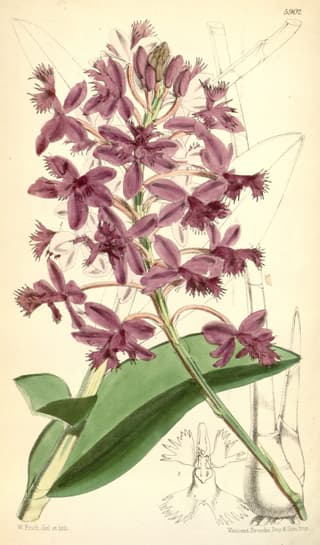
Jamieson's Epidendrum
Epidendrum jamiesonis
Epidendrum jamiesonis is a large, reed-stemmed terrestrial-to-epiphytic orchid native to the cool cloud forests of Colombia and Ecuador, found on trees and slopes between 1,700 and 3,500 meters elevation. Its sturdy cane-like stems carry evergreen leaves and terminate in showy inflorescences packed with numerous small, star-shaped flowers roughly 2.5 cm across. Unlike many orchids tied to a single bloom season, it can flower at almost any time of year given consistent moisture and bright light. First described by Reichenbach in 1856 and named for the Scottish botanist William Jamieson, who collected extensively in Ecuador, the species is now considered vulnerable in the wild due to habitat loss, making cultivated specimens valuable for ex-situ conservation.

Night-Scented Orchid
Epidendrum nocturnum
Epidendrum nocturnum, commonly called the night-scented orchid, is an epiphytic orchid native to Florida, the Bahamas, the West Indies, and Central America through to northern Brazil and the Guyanas. It grows tall, leafy reed-like stems up to about a meter high, topped with clusters of green to yellow-brown flowers with a broad white lip. The blooms open with a subtle daytime scent but release a powerful, sweet fragrance -- often compared to eucalyptus or anise -- after dark, which is how the species earned its name.
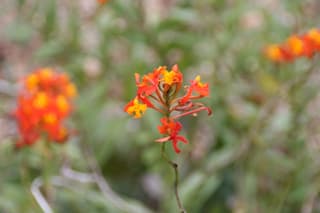
Reed-stem Epidendrum
Epidendrum radicans
Epidendrum radicans, commonly known as the Reed-stem Epidendrum or Crucifix Orchid, is a terrestrial orchid native to Mexico and Central America. It produces vibrant clusters of red, orange, and yellow flowers atop tall reed-like stems, forming a cross shape that gives it the name "crucifix orchid." It is one of the most adaptable and beginner-friendly orchids available.
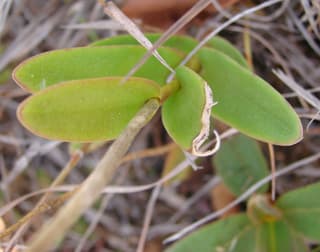
Crucifix Orchid
Epidendrum secundum
Epidendrum secundum, commonly known as the Crucifix Orchid, is a terrestrial and lithophytic orchid native to the Andean regions and Brazil. Its small, vibrant flowers bloom in dense clusters atop upright stems, in colors ranging from pink and red to orange, yellow, and white. It is one of the most resilient and adaptable orchids in the genus, capable of flowering nearly year-round under ideal conditions.

Willowherb / Fireweed (genus)
Epilobium
Epilobium is a genus of flowering plants in the family Onagraceae, found across temperate and subalpine regions worldwide. Species range from tall fireweed colonizers to delicate streamside willowherbs, producing characteristic pink to purple blooms in summer and fall.
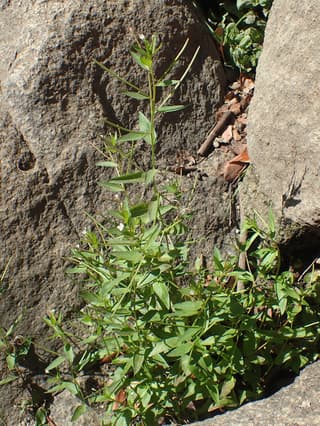
Fringed Willowherb
Epilobium ciliatum
Epilobium ciliatum, known as fringed willowherb, is a fast-growing herbaceous perennial in the evening primrose family (Onagraceae), native to North America and eastern Asia and now naturalized across Europe and other temperate regions. It forms upright, often branching stems covered in fine bristly hairs, topped with small four-petaled white to pale pink flowers with deeply notched petals and dark veining. Blooming from summer into fall, it is a magnet for pollinators and readily colonizes disturbed soil, roadsides, and moist waste ground.
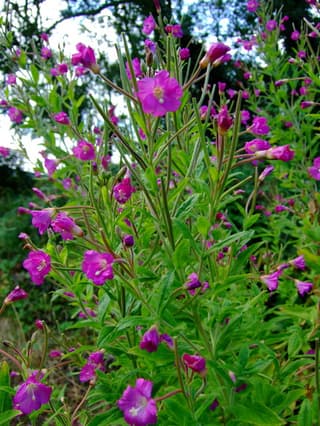
Great Willowherb
Epilobium hirsutum
Great willowherb is a robust, hairy-stemmed perennial native to Europe, North Africa, and temperate Asia. It thrives in wet meadows, riverbanks, and ditches, spreading by rhizomes to form dense stands up to 2 m tall. From June to September it bears soft pink, four-petaled flowers with a pale center, much loved by hoverflies and other pollinators, followed by long seed pods that release fluffy, wind-borne seeds.

Small-flowered willowherb
Epilobium parviflorum
Epilobium parviflorum is a hardy perennial herb native to Europe, North Africa and western Asia. It grows along stream banks, marshes and other damp, disturbed ground, forming clumps of soft, downy stems topped with small pink-to-purple four-petalled flowers from July to August. It is best known today as a traditional medicinal herb used in European folk medicine.
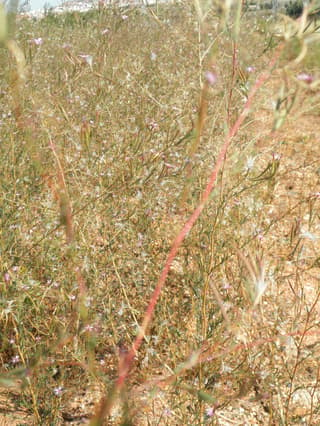
Square-stemmed Willowherb
Epilobium tetragonum
Epilobium tetragonum, known as square-stemmed willowherb, is an erect perennial wildflower native to Europe and western Asia, easily recognized by its hairless stem with four raised ridges arranged in a tetragonal pattern. It grows 30-130 cm tall and bears clusters of small pink-purple flowers with notched petals from July to September. Found naturally in damp woodland clearings, hedgebanks, ditches and streamsides, it adapts readily to garden borders and wildflower meadows.
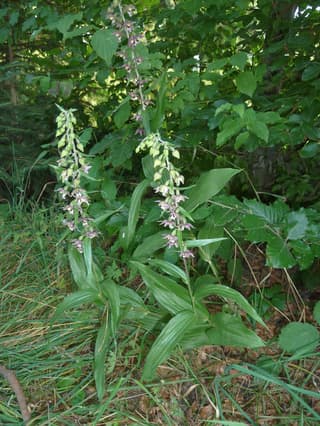
Helleborine
Epipactis
Epipactis is a genus of roughly 54 accepted terrestrial orchid species found across the temperate and subtropical regions of Europe, Asia, North Africa, and North America. Unlike the tropical epiphytic orchids seen in most collections, Epipactis species grow directly in the ground from creeping, fleshy rhizomes, sending up one or several leafy stems each year from spring through late summer. They favor the dappled light of open woodland, hedgerows, and scrub, though several species - including the North American Stream Orchid (Epipactis gigantea) - are equally at home along the damp margins of streams, springs, and lakes. A defining trait of the genus is its total dependence on mycorrhizal fungi in the soil: seeds carry almost no stored energy and cannot germinate without a fungal partner, and even mature plants rely on this underground relationship to take up nutrients. Flower spikes bear numerous small, often drooping blooms in shades of green, white, purple, and dusky pink, generally opening from midsummer into autumn. The best-known species, Epipactis helleborine, has proven remarkably adaptable, naturalizing far beyond its native Eurasian range and now appearing as a common, sometimes weedy, colonizer of parks, gardens, and city sidewalks in North America. Because of their fungal dependency, Epipactis orchids are considered specialist wild and woodland-garden plants rather than typical houseplants.
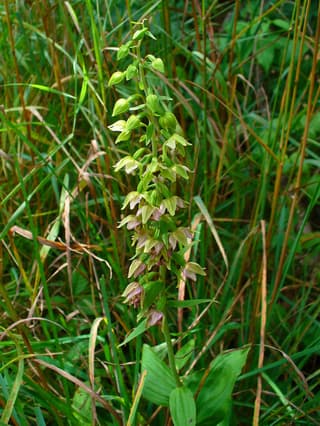
Broad-leaved Helleborine
Epipactis helleborine
Epipactis helleborine, commonly known as the broad-leaved helleborine, is a terrestrial orchid native to Europe and Asia. It grows in woodland settings, relying on mycorrhizal fungi for germination and survival. Its tall stems bear broad, ribbed leaves and a drooping raceme of greenish-purple flowers that bloom in summer.
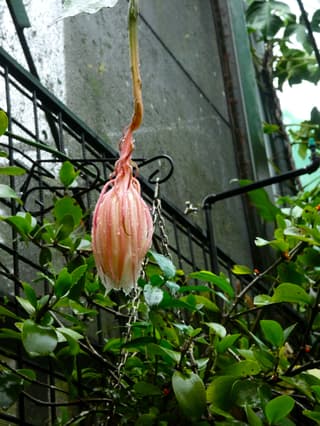
Orchid Cactus
Epiphyllum
Epiphyllum is a genus of epiphytic cacti native to the tropical forests of Central and South America. Unlike desert cacti, they grow perched on tree branches in dappled light, producing long, flat, trailing stems. They are celebrated for their spectacular flowers — enormous, often fragrant, and sometimes night-blooming — that last only one or two days, making each bloom a fleeting but unforgettable event.
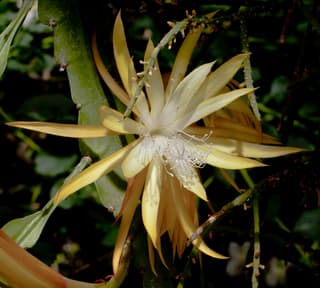
Fishbone cactus
Epiphyllum anguliger
The fishbone cactus is an epiphytic cactus native to the tropical forests of Mexico, where it grows attached to tree trunks and branches. Its flattened, deeply lobed zigzag stems resemble a fish's spine, and mature plants produce large, fragrant, night-blooming white flowers in late summer or fall.
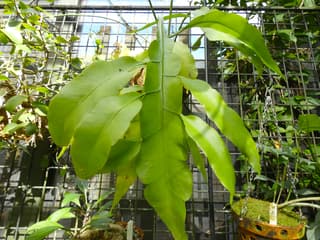
Queen of the Night
Epiphyllum oxypetalum
Epiphyllum oxypetalum is a spectacular epiphytic cactus native to Central America, famous for its stunning white nocturnal flowers that can reach up to 30 cm in diameter. The flowers open only for one night, releasing a sweet and intense fragrance, and wilt by dawn. It is a fast-growing plant that can reach up to 3 meters in height, with flattened stems that function as leaves (phylloclades) with wavy edges. Unlike other cacti, it has no spines.
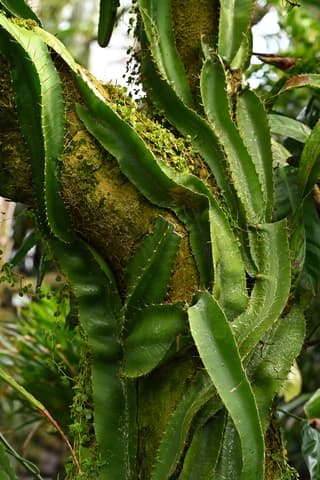
Climbing Cactus
Epiphyllum phyllanthus
Epiphyllum phyllanthus, commonly known as the Climbing Cactus or Orchid Cactus, is a tropical epiphytic cactus from the family Cactaceae, native to the forests of Central and South America. Unlike desert cacti, it grows on trees in humid, shaded environments and produces large, white, fragrant flowers that bloom only at night.
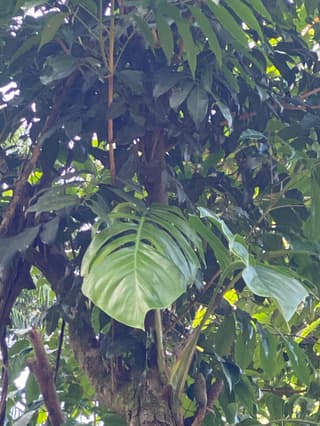
Pothos / Devil's Ivy (genus)
Epipremnum
Epipremnum is a genus of tropical climbing aroids in the family Araceae, native to Southeast Asia and the Pacific. It encompasses popular houseplant species like E. pinnatum and E. aureum, prized for their lush foliage, vigorous growth, and exceptional tolerance to indoor conditions including low light.

Golden Pothos
Epipremnum aureum
Epipremnum aureum, commonly known as Golden Pothos or Devil's Ivy, is one of the most popular and resilient houseplants. Native to French Polynesia, this evergreen vine features heart-shaped leaves with stunning golden-yellow variegation. Known for its air-purifying qualities, it thrives in various light conditions and is an excellent choice for beginners.
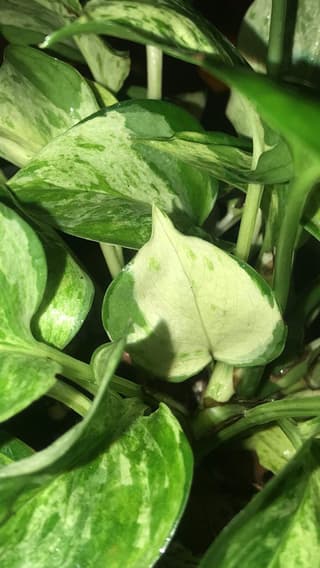
Manjula Pothos
Epipremnum aureum 'Manjula'
Manjula Pothos (Epipremnum aureum 'Manjula') is a patented pothos cultivar known for heart-shaped leaves splashed with cream, silver-green and white marbling and gently wavy edges. A fast-growing, easy-care vine, it trails beautifully from hanging baskets or climbs a moss pole, making it one of the most popular variegated houseplants.
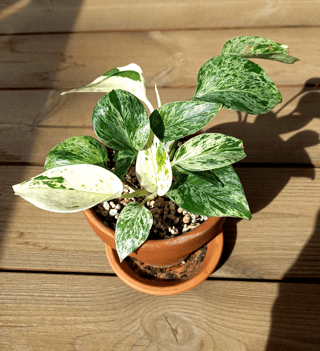
Marble Queen Pothos
Epipremnum aureum 'Marble Queen'
Marble Queen Pothos (Epipremnum aureum 'Marble Queen') is a popular variegated cultivar prized for its cream-and-white marbled heart-shaped leaves. A trailing vine native to tropical regions, it is widely grown indoors in hanging baskets or trained up moss poles, valued for its low-maintenance nature and striking foliage pattern.
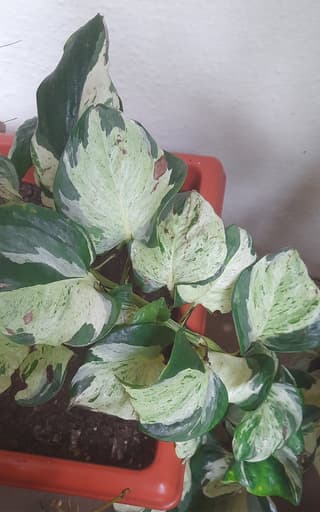
N'Joy Pothos
Epipremnum aureum 'N'Joy'
The N'Joy Pothos (Epipremnum aureum 'N'Joy') is a compact cultivar of the classic pothos, prized for its smaller, rounded leaves marked with crisp white-and-green variegation. Unlike some variegated pothos varieties, N'Joy holds its pattern fairly reliably even in average light, though brighter indirect light produces the whitest leaves. It's a slow-to-moderate grower, well suited to hanging baskets, shelves, or as a compact tabletop trailer.
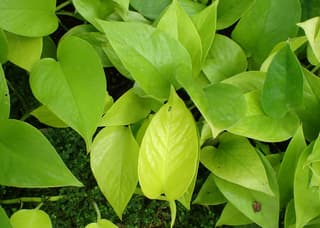
Neon pothos
Epipremnum aureum 'Neon'
Epipremnum aureum 'Neon' is a vibrant cultivar of golden pothos prized for its bright, solid chartreuse-yellow foliage, which darkens slightly with age or in lower light. A fast-growing, low-maintenance trailing vine, it looks stunning cascading from a hanging basket or climbing a moss pole.
Pearls and Jade Pothos
Epipremnum aureum 'Pearls and Jade'
A compact variegated cultivar of golden pothos, prized for its small heart-shaped leaves marbled in white, gray-green, and jade-green, often with a pink blush on new growth. Its slower, more compact trailing habit makes it a favorite for shelves and hanging baskets.
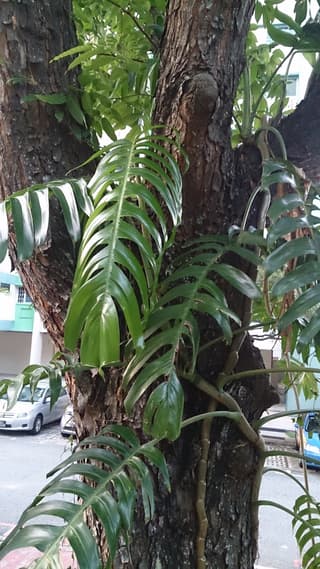
Dragon Tail Plant
Epipremnum pinnatum
Epipremnum pinnatum is a vigorous climbing aroid native to Southeast Asia and the Pacific Islands. It is celebrated for its dramatic leaf dimorphism: juvenile leaves are small and entire, while mature leaves become large, glossy, and deeply pinnately split. Related to but distinct from E. aureum (golden pothos), it is a fast-growing, adaptable houseplant and robust outdoor vine in tropical climates.

Flame Violet
Episcia cupreata
Episcia cupreata is a tropical creeping plant native to Colombia, belonging to the Gesneriaceae family. It features velvety leaves with stunning metallic patterns in shades of copper, silver, and green, along with tubular red or orange flowers that bloom throughout the year. Highly valued as a houseplant for its decorative foliage and trailing stoloniferous growth habit.

Flame Violet
Episcia reptans
Episcia reptans, commonly known as Flame Violet or Chocolate Soldier, is a creeping tropical plant in the Gesneriaceae family, native to the rainforests of the Brazilian Amazon and Colombia. Its velvety dark-green leaves with silver markings and vibrant scarlet tubular flowers make it one of the most striking houseplants available. It spreads naturally via stolons, creating a lush cascading display perfect for hanging baskets.
Find the Perfect Plant
Our plant guide helps you find ideal species for your experience level and time of year.
Browse by Difficulty, Season & More
Use the filters below to narrow this catalog by care difficulty, season, environment, or search directly by name. Each filter leads to a focused list tailored to your specific growing conditions.