Complete Plant Guide
Explore plants by difficulty, season and more. Find the perfect plant for you.
Difficulty
Categories
Plants by City
🗺️ Plants by City3454 plants found
Showing 2593-2628 of 3454
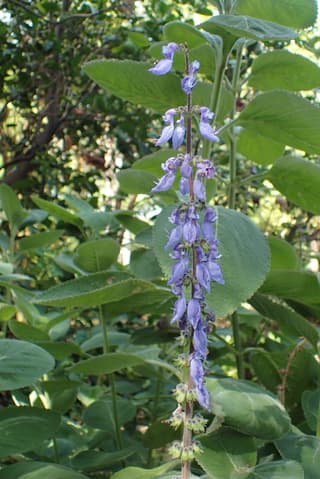
Indian Coleus
Plectranthus barbatus
Indian Coleus (Plectranthus barbatus) is a perennial shrub of the Lamiaceae family, native to the paleotropical regions of Africa and India. It is widely cultivated for its aromatic, slightly fuzzy leaves and striking blue-purple flower spikes. A fast-growing and drought-tolerant plant, it thrives in warm climates and is prized both as an ornamental and for its medicinal roots, which contain the bioactive compound forskolin.
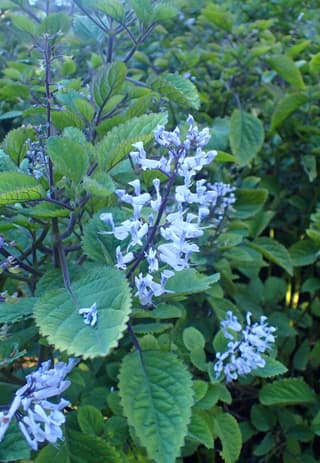
Speckled Spur-Flower
Plectranthus ciliatus
The Speckled Spur-Flower (Plectranthus ciliatus) is a trailing, semi-succulent perennial in the mint family (Lamiaceae), native to the moist forests and shaded slopes of South Africa's Western Cape, KwaZulu-Natal, and Eswatini. Its broadly oval, scalloped leaves are edged with fine hairs that give an eyelash-like fringe (hence "ciliatus", Latin for "fringed with hairs"), and the undersides often flush deep purple. From late summer into winter it sends up slender spikes of small white to lilac-pink flowers above the foliage. In its native habitat it forms dense, shade-loving carpets under trees, which makes it a natural fit for hanging baskets, window boxes, and groundcover plantings in frost-free gardens.
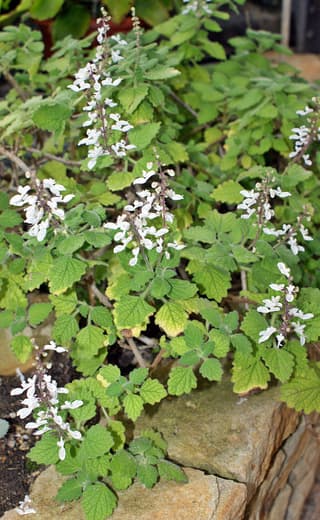
Mintleaf
Plectranthus madagascariensis
Mintleaf (Plectranthus madagascariensis) is a popular trailing houseplant native to Madagascar and South Africa. It features aromatic, slightly fuzzy leaves with white or cream margins in its variegated form, releasing a mild mint-like scent when touched. It is prized for its easy care, fast growth, and adaptability to indoor conditions.
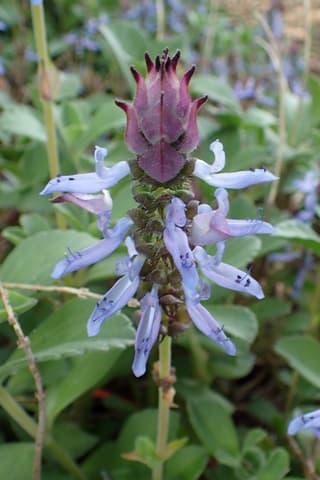
Lobster Flower
Plectranthus neochilus
Plectranthus neochilus is an aromatic groundcover native to South Africa, known for its pungent skunky scent that repels insects, cats, and snakes. It produces attractive blue-purple flowers in spring and summer and is prized for both ornamental and medicinal uses.
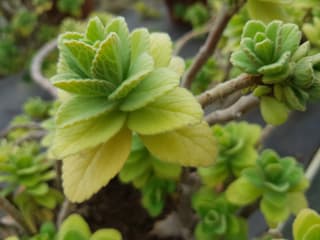
Vicks Plant
Plectranthus ornatus
Plectranthus ornatus, commonly known as the Vicks Plant, is a fast-growing aromatic groundcover native to East Africa (Ethiopia and Tanzania). Belonging to the Lamiaceae family, it is widely grown as both a medicinal herb and ornamental plant, prized for its menthol-like fragrance and digestive health benefits.
Purple Swedish Ivy
Plectranthus purpuratus
Plectranthus purpuratus, commonly known as Purple Swedish Ivy, is a trailing evergreen perennial in the mint family (Lamiaceae), native to eastern South Africa. It is prized for its soft, fleshy, aromatic dark green leaves with a purple-tinted underside, and its freely branching, spreading habit makes it a popular choice for hanging baskets. Tiny bluish-white tubular flowers appear in summer and intermittently throughout the year.
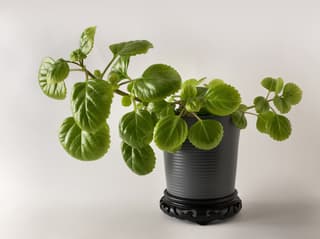
Plectranthus
Plectranthus sp
Plectranthus is a diverse genus in the Lamiaceae family, native to Africa and Asia. With over 350 species, many are cultivated as ornamental, aromatic, and medicinal plants. Their textured leaves and tubular flowers in shades of purple, lilac, or white make them a favorite for gardens and balconies. They adapt well to indoor containers as well as outdoor planting in tropical and subtropical climates.
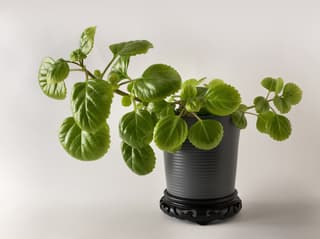
Swedish Ivy
Plectranthus verticillatus
Plectranthus verticillatus, commonly known as Swedish Ivy or Money Plant, is a fast-growing trailing perennial native to South Africa. It features oval, glossy green leaves with slightly serrated edges and a pleasant aromatic scent when touched. Widely grown as a houseplant, it thrives in hanging baskets and on shelves where its cascading stems create a lush, decorative display.
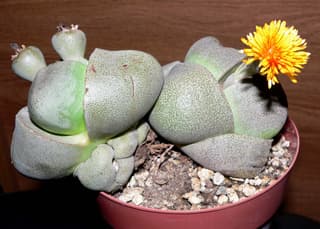
Split rock
Pleiospilos nelii
Pleiospilos nelii is a small, stemless succulent from the Aizoaceae family, native to the semi-arid Karoo regions on the border of the Western and Eastern Cape Provinces in South Africa. The plant produces only one or two pairs of thick, nearly spherical leaves in gray-green to reddish hues, covered with tiny dots that perfectly imitate the surrounding stones and quartz gravel—hence the common name 'living stones.' In autumn, a new pair of leaves emerges between the old ones, while the old leaves wither and dry up, transferring their water to the new growth. From July to August, the plant produces large, fragrant, yellow-salmon daisy-like flowers that turn orange over time.
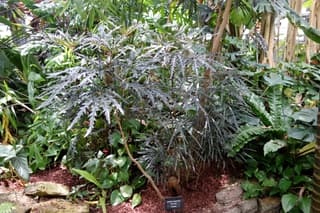
False Aralia
Plerandra elegantissima
Plerandra elegantissima, commonly known as False Aralia, is an elegant evergreen shrub native to the rainforests of New Caledonia. Prized for its finely divided, dark green to coppery leaves with serrated edges, this tropical plant brings a sophisticated, feathery texture to any indoor space. While it can grow up to 15 meters tall in its native habitat, indoors it typically stays between 1.5 and 2 meters, making it a striking yet manageable houseplant.
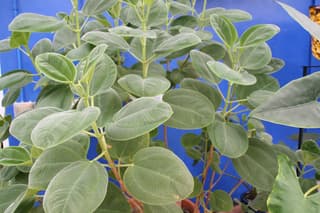
Pink Princess Flower
Pleroma granulosum
Pleroma granulosum (syn. Tibouchina granulosa), commonly known as Pink Princess Flower or Purple Glory Tree, is a fast-growing flowering tree native to Brazil's Atlantic Forest, belonging to the family Melastomataceae. It produces spectacular clusters of large violet-purple to magenta blooms mainly in late summer through autumn. Widely planted as a street tree and garden ornamental in tropical and subtropical regions worldwide.
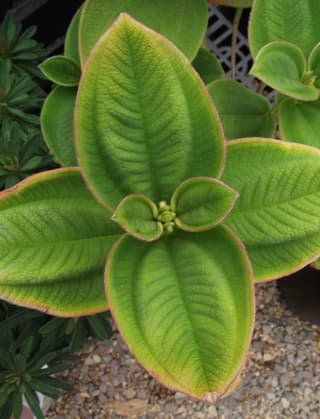
Silver-leaved Princess Flower
Pleroma heteromalla
Pleroma heteromalla, commonly known as Silver-leaved Princess Flower, is a shrub native to the Brazilian Cerrado, belonging to the family Melastomataceae. Previously classified as Tibouchina heteromalla, this species is prized for its velvety silver-gray foliage and vibrant purple flowers. Well-adapted to the challenging conditions of the Cerrado savanna, it is a resilient and ornamentally striking plant.
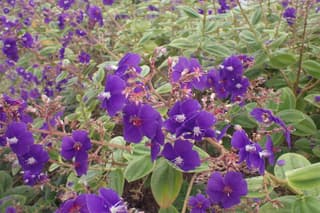
Glory Bush
Pleroma urvilleanum
Glory Bush (Pleroma urvilleanum, synonym Tibouchina urvilleana) is a stunning evergreen shrub native to Brazil's Atlantic Forest (Mata Atlântica). It produces brilliant violet-purple flowers up to 10 cm (4 in) across with distinctive dark stamens, blooming prolifically in summer and fall. Growing 3–6 m tall, it belongs to the family Melastomataceae and has earned the Royal Horticultural Society's Award of Garden Merit.
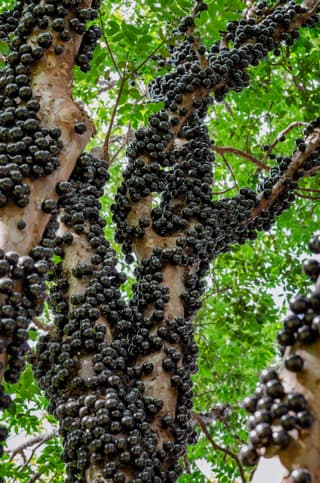
Jabuticaba tree
Plinia cauliflora
The Jabuticaba tree is an iconic Brazilian fruit tree, native to the Atlantic Forest. Its most striking characteristic is cauliflory, where white flowers and dark purple, globose fruits grow directly on the trunk and branches. The pulp is white, succulent, and sweet. It has a slow growth rate, with bark that peels off periodically, revealing lighter tones underneath.
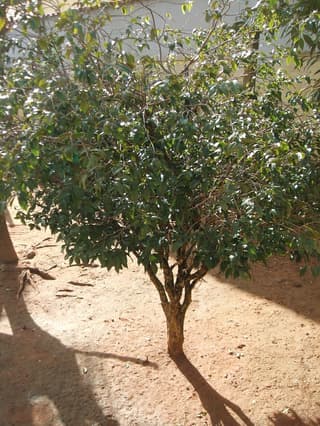
Jaboticaba
Plinia jaboticaba
Jaboticaba is a slow-growing, tropical evergreen fruit tree native to Brazil, belonging to the Myrtaceae family. It is renowned for its distinctive fruiting habit called cauliflory, where small white flowers and subsequent dark purple berries emerge directly from the trunk and older branches. The fruits are thick-skinned berries with sweet, white or rosy-pink gelatinous pulp inside, resembling grapes in flavor and texture. Dense and profusely branched, the tree develops a rounded crown and can live for decades. It is valued both as an ornamental specimen for its unique structure and as a productive fruit tree, with cultural significance dating back centuries in Brazil.
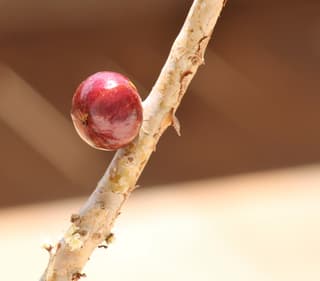
Stalked Jabuticaba
Plinia trunciflora
Stalked Jabuticaba (Plinia trunciflora) is a native Brazilian fruit tree from the Atlantic Forest, belonging to the Myrtaceae family. It is distinguished by its glossy black fruits hanging on long stalks (peduncles) directly from the trunk and branches — a phenomenon known as cauliflory. The fruits have a sweet flavor reminiscent of coffee. The tree can reach up to 15 meters in its natural habitat, with a globose canopy and pendant branches.

Camphor Weed
Pluchea
Pluchea is a genus of aromatic shrubs in the Asteraceae family, commonly known as camphor weeds or marsh fleabanes. Native to tropical and subtropical regions of the Americas, these robust plants are widely used in traditional medicine for their anti-inflammatory, antioxidant, and antimicrobial properties. Leaves emit a characteristic camphor-like aroma and produce clusters of small pink or lilac flower heads.
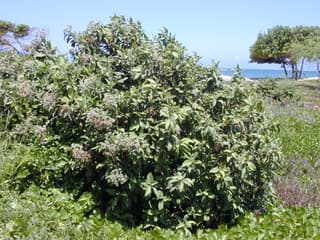
Cure-for-all
Pluchea carolinensis
Cure-for-all (Pluchea carolinensis) is an aromatic, fast-growing perennial shrub native to the Caribbean, Florida, and Central and South America. Its velvety, camphor-scented leaves and delicate pink-lavender flowers make it both ornamentally attractive and medicinally prized. Widely used in Caribbean and Brazilian folk medicine for centuries, it is traditionally employed to treat colds, fever, bronchitis, sore throats, and rheumatic pain. It thrives in full sun and well-drained soils, reaching up to 2.5 m in height.
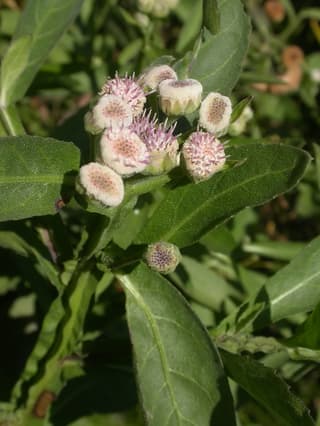
Wingstem Camphorweed
Pluchea sagittalis
Wingstem Camphorweed (Pluchea sagittalis) is an aromatic medicinal herb native to South America, notable for its winged stems and small pink to white flowers. It thrives in warm, humid environments and has a long history of use in traditional medicine across the continent.
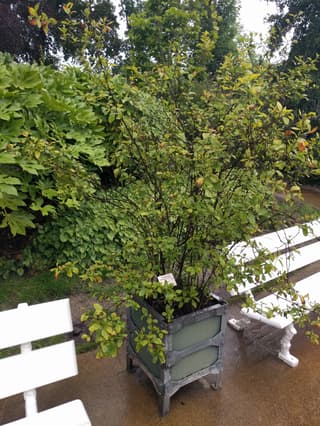
Cape Leadwort
Plumbago auriculata
Cape Leadwort (Plumbago auriculata) is an evergreen or semi-evergreen shrub native to South Africa, prized for its clusters of sky-blue, trumpet-shaped flowers that appear almost continuously from spring through fall. A vigorous grower, it can behave as a climber when supported by walls and trellises or form hedges and groundcover. It tolerates a wide variety of soils and is drought-resistant once established, though it is sensitive to waterlogging and frost.

Frangipani
Plumeria
Plumeria is a genus of about a dozen species of deciduous flowering trees and shrubs native to tropical and subtropical parts of the Americas, prized worldwide for their fragrant, waxy flowers and smooth gray bark. Grown as a landscape tree in frost-free climates and as a container plant elsewhere, frangipani produces clusters of five-petaled blooms in white, yellow, pink, and red from late spring through fall, followed by a leafless winter dormancy in cooler regions.
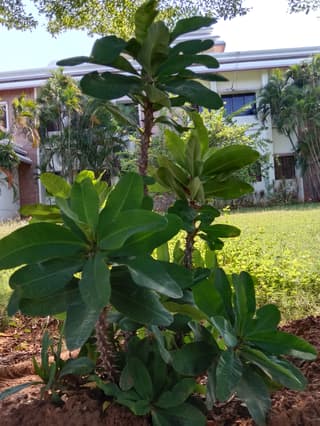
White Frangipani
Plumeria alba
Plumeria alba, commonly known as white frangipani or West Indian jasmine, is a small deciduous tree in the Apocynaceae family, native to Puerto Rico and the Lesser Antilles in the Caribbean. It grows up to 7.5 meters tall, with thick, succulent branches that release a milky sap when cut. Its fragrant white flowers with yellow centers bloom in clusters at the branch tips.
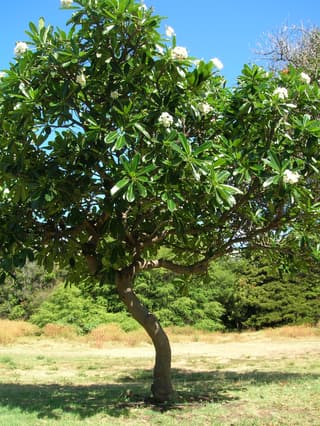
Singapore Graveyard Flower
Plumeria obtusa
Plumeria obtusa, commonly known as the Singapore graveyard flower or white frangipani, is a tropical tree in the family Apocynaceae native to the Caribbean and Central America. It is widely cultivated across Southeast Asia, Hawaii, and tropical regions worldwide for its intensely fragrant white flowers with yellow centers. The species is semi-evergreen in tropical climates and is a staple of temple gardens throughout Asia.
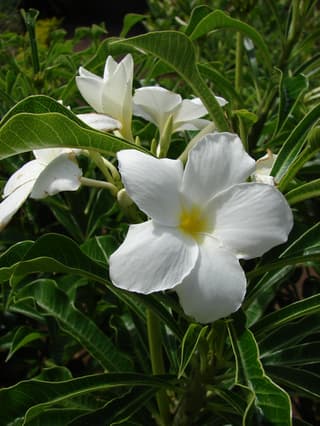
Bridal Bouquet
Plumeria pudica
Plumeria pudica, commonly known as Bridal Bouquet or Fiddleleaf Plumeria, is a tropical shrub native to Panama, Colombia, and Venezuela. It stands out for its distinctive fiddle-shaped (spatula-like) leaves and clusters of pure white flowers with yellow centers. Unlike most plumerias, it is evergreen and does not drop its leaves seasonally, making it an exceptional ornamental plant for tropical and subtropical gardens.
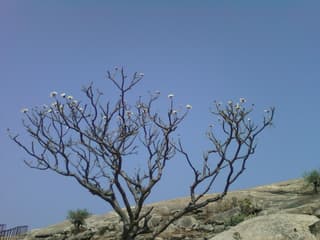
Frangipani
Plumeria rubra
Frangipani (Plumeria rubra) is a deciduous shrub or small tree native to Mexico and Central America, celebrated worldwide for its intensely fragrant, waxy flowers in shades of white, yellow, orange, pink, and red. It thrives in hot, sunny climates, tolerates drought once established, and is among the most iconic tropical ornamental plants in the world. It grows rapidly and can reach 2–8 meters in height.
Pleated Pluteus
Pluteus longistriatus
Pluteus longistriatus, commonly known as the Pleated Pluteus, is a small, delicate mushroom characterized by its deeply radial striations on the cap. The cap is typically brownish to grey-brown, often with a darker center. It is a saprobic fungus, meaning it derives nutrients from decaying wood, particularly hardwood logs and debris in forest ecosystems.
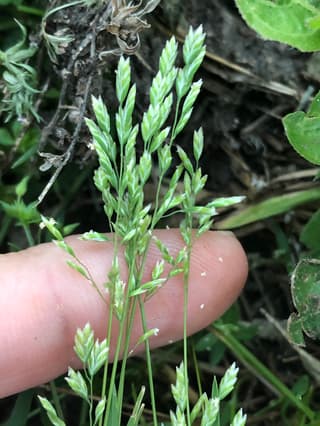
Annual Meadow Grass
Poa annua
Poa annua, commonly known as Annual Meadow Grass or Annual Bluegrass, is a small, tufted annual or short-lived perennial grass native to temperate Europe and Asia but now found worldwide. It forms dense low mats of fine-textured, bright yellow-green blades with characteristic boat-shaped leaf tips. Despite often being considered a lawn weed, it is also cultivated on golf-course putting greens and used as a ground cover in low-maintenance areas. It germinates in cool weather, flowers in spring, and dies back as summer heat arrives.
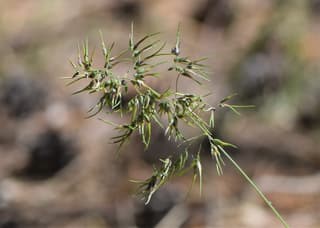
Bulbous Bluegrass
Poa bulbosa
Bulbous Bluegrass (Poa bulbosa) is a perennial grass native to Europe and the Mediterranean, now widespread globally. It forms dense clumps up to 70 cm tall with distinctive bulbous stem bases that store water reserves, making it extremely drought and cold tolerant. In spring it produces small spikelets that develop into bulbils for vegetative reproduction.
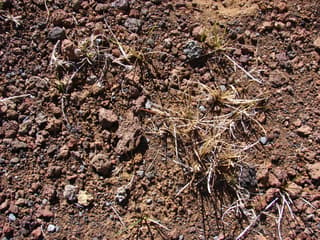
Kentucky bluegrass
Poa pratensis
Poa pratensis, commonly known as Kentucky bluegrass or smooth meadow-grass, is a perennial cool-season grass native to Europe, northern Asia, and the mountains of Algeria and Morocco. Widely naturalized across North America, it is one of the most popular turfgrasses in the world, prized for its fine texture, attractive blue-green color, and dense sod-forming ability through underground rhizomes. It thrives in cool, humid climates and is extensively used for lawns, athletic fields, golf courses, and pastures in USDA hardiness zones 3a–7b.
Supine bluegrass
Poa supina
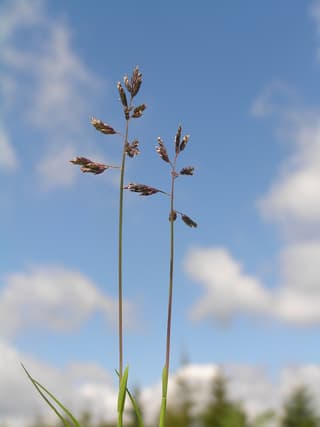
Supine bluegrass (Poa supina) is a low-growing perennial grass native to the alpine and subalpine regions of Europe. It is distinguished by its smooth, soft, bright green leaves and its creeping habit, which forms a dense turf through stolon propagation. It is one of the few grasses capable of thriving in conditions of intense shade, up to 90% shade, making it ideal for difficult areas such as under dense trees, walkways, and sports fields in shady environments. In spring, it produces seed heads with characteristic purplish coverings.
Lawn grass
Poaceae
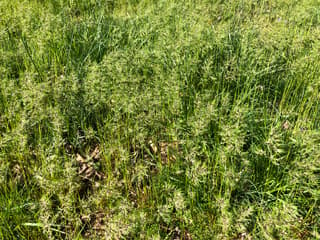
Poaceae, the grass family, is one of the world's most widespread and species-rich plant families, forming the foundation for most lawns, pastures, and sports fields. Lawn grass is characterized by narrow, elongated leaves and a dense, fibrous root system that, along with runners (rhizomes and stolons), creates a cohesive, durable green carpet. Depending on the species, a distinction is made between cool-season grasses (e.g., Kentucky bluegrass and perennial ryegrass), which thrive best in temperate climates, and warm-season grasses (e.g., Bermuda grass), which prefer warmer regions. Grass is extremely hardy, tolerates mowing and foot traffic well, and is a central component of gardens, parks, and public spaces worldwide.
Satin Bush
Podalyria sericea
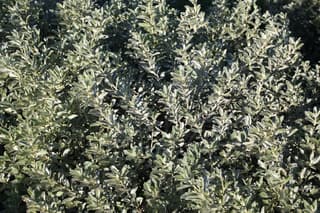
A small, evergreen shrub reaching about 1 m in height and width, native to the sandstone and granite outcrops of Cape Town, South Africa (from Saldanha Bay to the Cape Peninsula). The leaves are covered in long, shiny hairs that give it a silky, silvery appearance. Between autumn and winter (May to August in the Southern Hemisphere), it produces small pink flowers with white centers, typical of legumes (Fabaceae), followed by inflated pods containing several seeds. It is classified as "Vulnerable" due to habitat loss, invasive alien plants, and frequent fires.
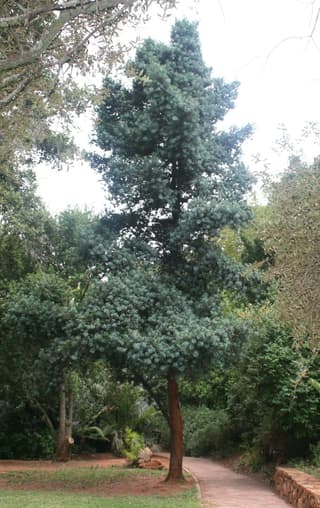
Breede River Yellowwood
Podocarpus elongatus
Podocarpus elongatus, commonly known as the Breede River yellowwood, is an evergreen conifer native to the Western Cape of South Africa, where it grows along the Breede River valley and into the Cederberg mountains. Unlike its taller yellowwood relatives, it typically forms a broad, multi-stemmed, rounded shrub or small tree with elongated grey-blue needle-like leaves, though in sheltered, well-watered ravines it can reach up to 20 m. It is the only South African yellowwood able to resprout from its roots and trunk after fire or flood damage, making it exceptionally resilient in its native fynbos habitat.
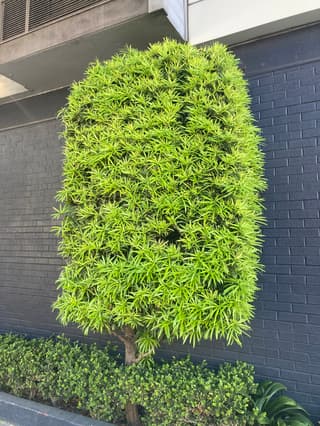
Buddhist Pine
Podocarpus macrophyllus
Podocarpus macrophyllus is an elegant evergreen conifer native to Japan and China. It features narrow, leathery, deep green leaves that resemble flattened needles. It is widely used in landscaping to create dense hedges, green columns, or as a standalone specimen, and is also a popular choice for the art of bonsai due to its malleability and controlled growth.
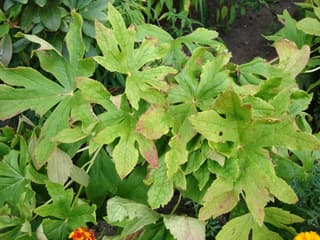
Himalayan Mayapple
Podophyllum hexandrum
The Himalayan Mayapple (Podophyllum hexandrum, synonym Sinopodophyllum hexandrum) is a perennial herbaceous plant in the barberry family (Berberidaceae), native to the Himalayan mountains at altitudes of 2,400–4,500 m in China, Afghanistan, Bhutan, India, Kashmir, Nepal, and Pakistan. In spring, the plant produces two deeply lobed leaves and a single white to pink flower, followed by a red, berry-like fruit. The plant is extremely toxic—the roots and rhizomes contain podophyllotoxin, which is used to produce cancer drugs (such as etoposide)—therefore, it must be handled with great care and kept far away from children and pets.
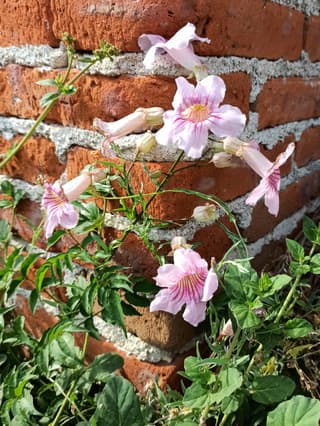
Pink Trumpet Vine
Podranea ricasoliana
Podranea ricasoliana, commonly known as Pink Trumpet Vine or Port St. Johns Creeper, is a vigorous woody climber in the family Bignoniaceae, native to South Africa. It produces spectacular lilac-pink, trumpet-shaped flowers with violet veining that bloom profusely from summer through fall. A fast grower capable of reaching 5 metres (16 ft), it is prized for covering pergolas, walls, and fences with a lush tropical floral display.
Find the Perfect Plant
Our plant guide helps you find ideal species for your experience level and time of year.
Browse by Difficulty, Season & More
Use the filters below to narrow this catalog by care difficulty, season, environment, or search directly by name. Each filter leads to a focused list tailored to your specific growing conditions.